
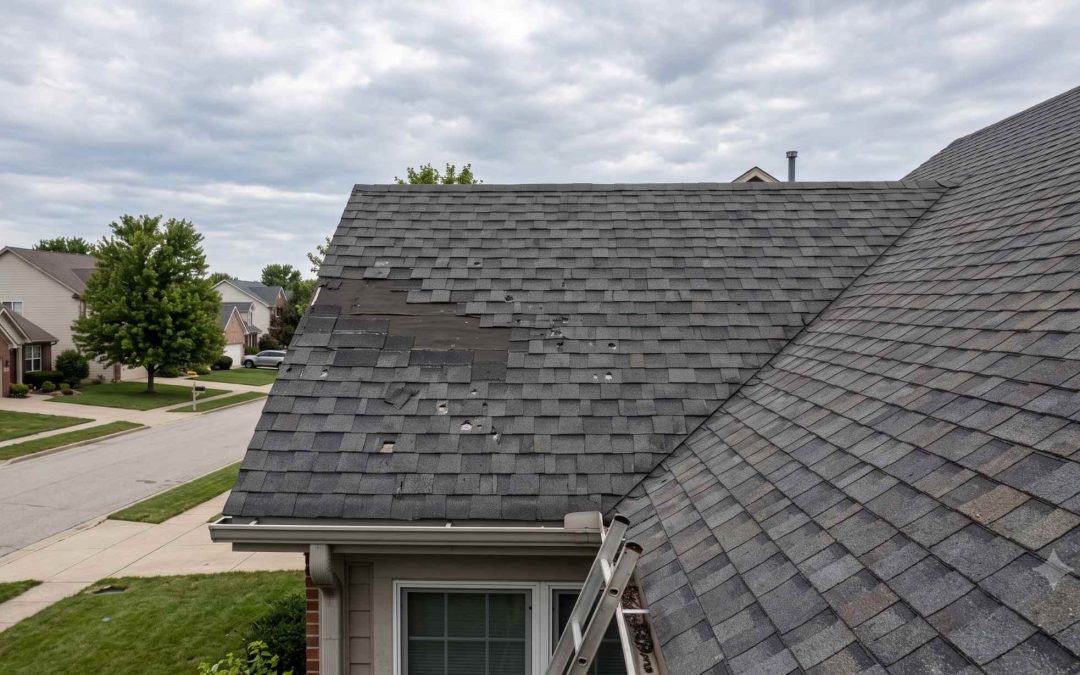
In the aftermath of Midwestern storms, property owners frequently encounter a critical insurance challenge regarding a partial loss: whether an insurance carrier must pay to replace an entire roof if only a section is physically damaged. In Minnesota, the intersection of statutory requirements, state supreme court rulings, and strict municipal building codes dictates how a roof must be restored. At Angell’s Construction Services, we leverage these legal frameworks to secure full code-compliant replacements rather than temporary patches that compromise your home’s structural integrity.
Key Minnesota Insurance and Code Rules
- The “Campbell” Rule: The Minnesota Supreme Court ruled in Great Northwest Insurance Co. v. Campbell that insurers must pay to bring underlying layers (like roof decking/sheathing) up to code if standard manufacturer instructions require it during shingle replacement.
- Line-of-Sight Matching: Minnesota Department of Commerce guidelines mandate that if a matching shingle color or profile is unavailable, the insurer may be required to replace the entire contiguous slope or face to ensure a uniform appearance.
- Partial Loss Under §65A.10: State law mandates that replacement cost insurance must cover the expense of rebuilding or repairing damaged property in accordance with the minimum state or local building codes.
- Exclusions Invalidated: Policies containing endorsements that attempt to limit coverage to only the “outermost layer” of roofing material can be legally challenged if code updates require underlying structural repairs.
What did the Minnesota Supreme Court rule regarding roof replacement cost?
In a landmark decision (Great Northwest Insurance Co. v. Campbell), the Minnesota Supreme Court clarified an insurer’s financial obligation during a partial storm loss. The court held that under Minnesota Statute §65A.10, replacement cost insurance is legally obligated to cover the cost of underlying structural repairs if a local building code demands those upgrades to complete the main repair.
Specifically, the ruling established that if a roof’s outer shingles are damaged by hail or wind, and the Minnesota State Building Code requires a uniform, gap-free substrate (decking) to install the new shingles properly, the insurer cannot deny coverage for the new wood sheathing underneath. This ruling effectively nullified standard insurance policy “Roof Damage Limitation” endorsements that attempted to restrict payments exclusively to the outermost layer of a roofing system.
Does my insurance company have to match my existing shingle color?
Matching rules protect the visual and financial value of your property. Under Minnesota’s insurance regulatory framework, if your roof suffers a partial loss and the original shingles are discontinued or structurally faded, the carrier cannot force you to accept a mismatched patch that creates a “checkerboard” appearance.
If a reasonable match cannot be sourced within the local market, the insurer is generally required to replace the entire uniform slope or face of the roof within the direct line of sight. At Angell’s Construction Services, we utilize digital color matching technology and pull physical shingle samples to submit directly to insurance adjusters, demonstrating when a proper match is physically unavailable and a full exterior remodeling slope replacement is required.
What underlying roof layers are covered by code-compliance laws?
When an insurance carrier approves a shingle claim, the code-compliance protections of Minnesota Statute §65A.10 extend to the secondary layers that form a safe, waterproof barrier. When we strip back damaged shingles, the following layers must be inspected and brought up to modern regulatory standards:
- Roof Sheathing (Decking): Code requires a solid, uniform wood deck. If old board gaps exceed one-eighth of an inch, or if the wood has degraded over time, the underlying layer must be completely sheeted over or replaced.
- Ice and Water Shielding: The building code mandates a self-adhering polymer-modified bitumen sheet extending from the eave edge to a point at least 24 inches inside the exterior wall line to protect against severe winter ice dams.
- Drip Edge Installation: Modern code requires a rigid metal drip edge along both the eaves and rakes to direct water run-off safely into the gutters and protect the fascia and siding.
Why are insurers denying general contractor overhead and profit?
A secondary element of recent court rulings involves the exclusion of General Contractor Overhead and Profit (O&P)—typically an additional 20% flat fee added to an estimate for complex project coordination. The court ruled that insurers are not automatically obligated to pay O&P unless the homeowner can prove that a general contractor’s management is structurally necessary to execute the code-required repairs.
Because storm damage often involves a combination of roofing, siding repairs, and shattered window installations, hiring a single trade roofer is rarely sufficient. Angell’s Construction Services provides the comprehensive multi-trade management required to justify O&P to your carrier, managing multiple structural elements to return your home to its pre-storm condition safely.
How do I handle a partial loss denial from my insurance adjuster?
If an adjuster provides an estimate that only covers a small patch of shingles on a roof system that cannot be legally or visually matched, you have specific paths of recourse under Minnesota’s Right to Repair standards:
- Request a Detailed Scope of Denial: Demand a written explanation citing the exact policy exclusions your carrier is invoking.
- Pull Local Municipal Building Codes: Secure the precise written code requirements from your local building official regarding shingle installation substrates and ice shield boundaries.
- Invoke the Appraisal Clause: If the dispute is over the amount of the loss or the cost of matching materials, you can trigger your policy’s appraisal clause to bring in independent neutral evaluators.
Expert Insight: “Carriers frequently try to treat a roof like a series of disconnected parts to save on claim payouts. But under Minnesota law, your roof is a unified system. If the law requires a code upgrade to make the shingle repair legal, the insurance company is on the hook for that cost—regardless of what fine print they have stamped on their endorsements.” — Angell’s Construction Project Director
Do you have an insurance estimate that only covers a partial patch of your roof? Contact Angell’s Construction Services today for a comprehensive, code-compliant evaluation that protects your property value.